Class 506 EMUs
The LNER class 506 was a fleet of eight three-car electric multiple units (EMUs) built in 1950 but ordered by Sir Nigel Gresley in 1938.
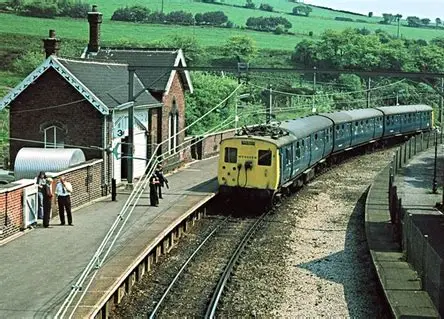
The British Railways class 506 was a three-car electric multiple unit (EMU) designed for suburban services on the Manchester–Glossop–Hadfield route and operated from 1954 to 1984, exclusively on the 1,500 V DC Woodhead Line.
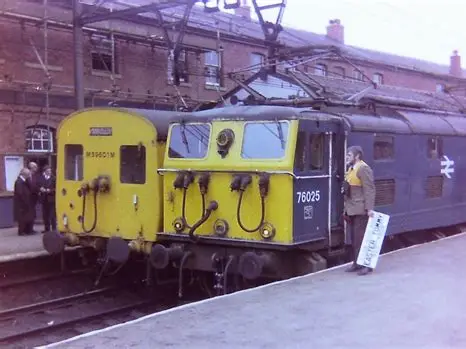

Eight three-car Class 506 units were ordered in 1938 by the Sir Nigel Gresley for the LNER and built in 1950, but they did not enter service until June 1954 due to World War II delays and infrastructure work on the Woodhead Line.
The units were constructed by Metro Cammell and the Birmingham Railway Carriage and Wagon Company, and were similar in design to the Class 306 EMUs built for suburban lines in London.
Each unit comprised:
A Driving Motor Brake Third (MOBS) with 52 seats
A Trailer Composite (TOS) with 24 first-class and 38 third-class seats (later all second-class)
A Driving Trailer Open Second (DTOS) with 60 seats
Units could be combined into six-car formations during peak hours, with six of the eight units deployed in service on weekdays, leaving one spare and one under overhaul. The class 506 was equipped with air-operated sliding doors and electro-pneumatic brakes.
Each driving motor car housed four 185 hp GEC traction motors, giving these EMUs sufficient power for the suburban services they were intended to serve. Their design prevented operation on lines electrified with 25 kV AC due to their DC-only equipment, limiting them to the Woodhead Line.
Class 506 EMUs operated local services between Manchester Piccadilly, Glossop, and Hadfield, with round trips taking nearly 90 minutes and a peak frequency of every 30 minutes. They rarely ventured east of Hadfield due to low gearing and overheating concerns, though trials were conducted in 1969 for potential use through the Woodhead Tunnel.
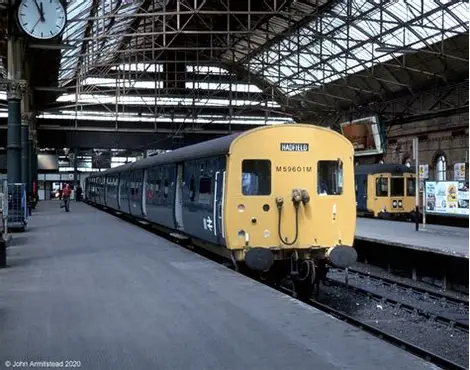
The closure of the Woodhead line east of Hadfield in 1981 and the conversion to 25 kV AC in December 1984 led to the withdrawal of all Class 506 units. The final service ran on 7 December 1984.
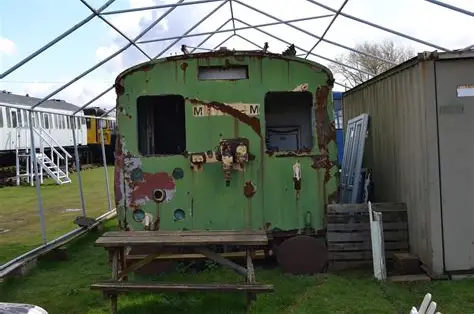
Most units were scrapped, though unit No. 59404-59504-59604 was allocated for preservation, initiall at Dinting Railway Museum and later moved to Midland Railway at Butterley. After severe deterioration, only a severed driving end of the motor car survives, preserved by The Cab Yard in Wales.
To find out more about the class 506s, visit wikipedia. Volume 10B of the RCTS ‘Locomotives of the LNER’ covers the class in detail.